
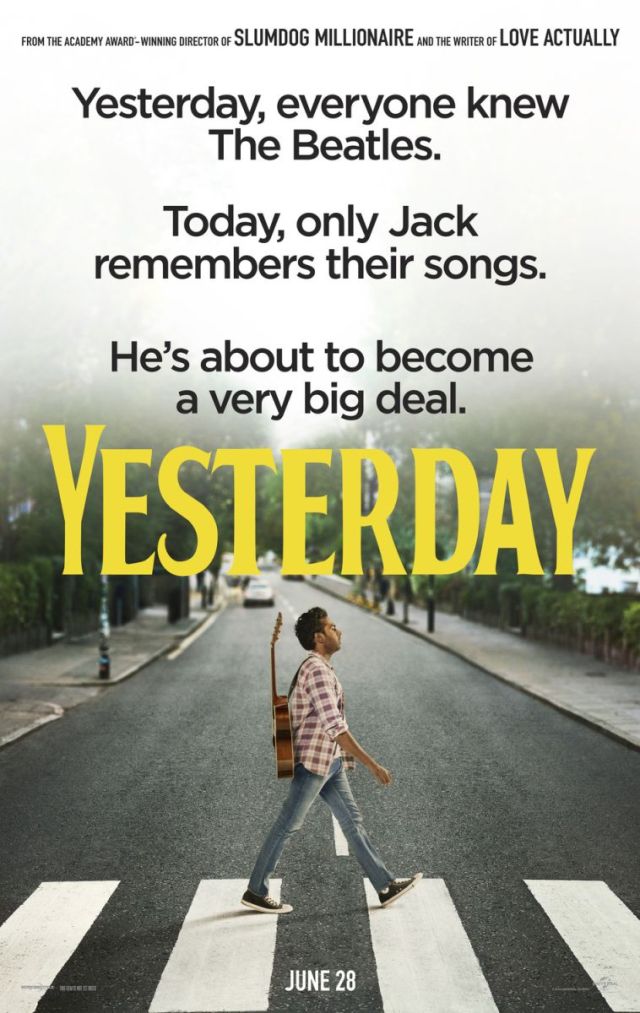
“Yesterday”, for anyone living in a cultural vacuum of late, is a Danny Boyle-directed, Richard Curtis-penned new film in which struggling musician Jack Malik (played by Himesh Patel) emerges from a worldwide blackout as apparently the only person on Earth who remembers The Beatles. Lily James plays his love interest Ellie, while the film also prominently features Kate McKinnon and, yes, Ed Sheeran. Boyle seems a half-decent choice for the sort of big, British event cinema Curtis likes to write, having directed harder-hitting flicks in a strangely similar vein and, most memorably, coordinated the opening ceremony of the 2012 Olympic Games in London to huge fanfare. I’m not going to comment much on Boyle’s contribution here; it is slick and efficient. I didn’t find anything interesting about it, which to me is probably a criticism. I have enjoyed his films before, but as we shall get into, a director does need subject matter. In terms of directing, nothing jumps out here. In terms of its substance, the film raises many interesting questions about nothing less than the nature of art, but not in as profound a fashion as that sentence might first suggest.
The main question this film raises for me is about how we should treat art vis-à-vis its intentions. If Curtis just wished to write another nicey-nicey film in the style of “Notting Hill” and “Love Actually”, two very popular and enduring films, and happened to stumble upon a way to do it which plays out on the backs of The Beatles’ music, is that OK? That is what has happened, after all. This film is perfectly fun to watch once. It is going to sound like I am annihilating it in the upcoming paragraphs. In truth I am, but there is a shadow version here where I have no qualms with this as a form of mass entertainment. I am no different to anyone else in that I go to the cinema as a form of escapism. However, I don’t think it is unfair to say I am possibly more interested in the artform than some, and certainly music is my favourite artform. A question “Yesterday” brings into view is whether I have any right to traduce something which failed to live up to my expectations if those expectations were formed from an entirely different angle to that from which Richard Curtis decided to write the script.
First learning that acts like The Beatles and The Beach Boys (more on them later) were among the most important groups in the history of popular music not just for their trailblazing pop but also for later becoming impossibly influential and keenly experimental bands who embraced the possibilities of the album and of musical recording is a critical rite of passage for any discerning music nerd, along with the Aphex Twin phase or the discovery of Norwegian black metal to name but a couple. Very little of the former’s finest moments in this second regard (I’m talking “Tomorrow Never Knows”, “A Day In The Life,” “Happiness Is A Warm Gun” etc) feature here. There are only 16 tracks from the entire catalogue employed in the film, and they lean heavily towards the pop end of the spectrum, although some of their best known later tracks do feature. All 16 tracks are great songs in my opinion, but it feels like a massive oversight to not highlight everything which made the band so mercurial.
One butterfly effect of The Beatles’ disappearance from the canon is that Oasis do not exist. Malik mutters “that figures”, for a neat little gag. At this point the question is why The Fratellis existed then? They exist prominently in fact, featuring on Malik’s wall and a t-shirt he wears. This is a bizarre inconsistency and it does feel churlish to rip the film apart to this detail, but expecting us to follow this is a huge ask! The Beach Boys are not mentioned despite the creative rivalry between The Beatles and Brian Wilson driving the late 60s magnificence of both outfits. I accept that you cannot mention every act going in this context, but to be thrown merely one bone would be lovely. It means that the film is not seriously approaching the premise it has been set up to tackle, which is very simply “what does a world without The Beatles look like?” If the answer is “Oasis don’t exist”, it’s not the most inspiring deconstruction. I have heard many music fans, mostly of the metal persuasion, ask the question of whether The Beatles would succeed if they emerged today. It is usually asked sneeringly, but is a good question. It is asked the wrong way around really as The Beatles obviously wouldn’t need to exist today and the question of what music history would be like if you removed them is the correct chronological rendering of the idea, or at least one which doesn’t ignore the fact that “Helter Skelter” is sometimes considered the first ever heavy metal recording. However, on paper it seems correct to say that there is no guarantee that a Beatles canon dropped into contemporary culture would succeed as easily as it does in this movie. Additionally, we may never know who Curtis had to call to get Neutral Milk Hotel’s name into this script.
History is written by the victors and Curtis can have his way in this script. He imagines a scenario where the magic of The Beatles’ music is all-winning, irrespective of era or cultural context. This is pure Hollywood and doesn’t celebrate their music in the way he thinks it does. The film is a wishy-washy diet product if you want any considered historical thought. In truth, Curtis abrogates any effort to grapple with his central issue via the scene in which two other characters present who, it turns out, also remember The Beatles. Initially the scene is correctly pronounced as foreboding, until we discover that they have only arrived to kiss Malik’s feet. If this actually played out, you have to suspect that the ensuing battle over the legacy of The Beatles would be far more fraught and bloody. No though, in “Yesterday”, The Beatles only have to be brought back into existence and that is enough (literally in the case of a late scene with ‘John Lennon’, which given the film’s mishandling of his music is surprisingly sweet). It is simpler not to ask what anything means. As I’ve already questioned though, does this matter? If people enjoy the film (and many critics have, audiences even more so), is my dislike of how it treats The Beatles even remotely relevant?
Many commentators have rightly raised the fact that Patel is British of Indian origin. The question that this raises is whether casting alone can be considered transgressive, independent of any evidence of exposition in the script? We can delve into the question here because this film is almost entirely free of any reference to race, weirdly given the circumstances. Casting an ethnic minority individual to carry the music of the band in this film is more becoming of the revolutionary elements of not just The Beatles’ early pop work but also their incredible strides in the second half of their career, truly reinvigorating the album format. Yet seemingly midwifing (some of) this music into the world runs without consequence in Curtis’ world. Malik’s race is essentially never mentioned during his meteoric rise. This could definitely be said to be welcome, although this universe is not entirely post-race. “The Beatles” album’s better known monicker of “The White Album” is utilised for a weak gag which is the only direct reference to Malik’s race, while a genuinely funny quip is made about Ed Sheeran’s toe-curling rapping and its relation to race issues. I can’t remember anything else. When you project this movie into our own society, you can’t help wondering if, when Kate McKinnon’s agent, no fan of mincing words, asks Malik “is this the best you can look?”, she might not be stating a preference that he was white.
Our world is certainly not perfect. Indeed, it is racist. I would certainly lean towards casting not having provocative potential on its own when a film goes so far out of the way to turn its head from the issue, but the other question raised here is this; is there any point in a film existing if it makes no attempt to interrogate the conditions of the world it is actually being made for? Is it OK for art in an unjust world not to make an attempt to interface with that same injustice? I have an obvious opinion on that but ultimately it’s not for me to decide; the almighty rule of the box office will be the final arbiter. “Yesterday” is unknowingly raising these issues loudly, however, for sure.
For Curtis, nothing bad ever happens. In a laughable turn of events prior to the film’s conclusion, after Malik has declared his long-dormant love for Ellie, Ellie’s current partner simply steps aside for them to be together. Is this feasible? I’m a big fan of suspending disbelief and consider it utterly essential to enjoy cinema, until it starts to spill over so relentlessly into cracks which run throughout a film. Curtis has no shortage of form for this and the ending here could only more strongly resemble a satire of a happy-ever-after trope if the dreamy couple literally ended up with 2.4 children. As is probably clear from this write-up, James’ character is almost entirely inconsequential. She is a cardboard cut-out hanging around until Malik decides he does love her after all. How he hadn’t realised this earlier wasn’t borne out by the writing, to me. The problem with all of this is that a supposed examination of what would happen if everyone on Earth except three people forgot The Beatles deserves better. It goes without saying that a film deeply and richly exploring that concept would be almost impossible to write in scope and implication, but this never truly approaches the same orbit.
McKinnon gives a playful turn, the film’s acting highlight for me, as Malik’s power-hungry, wealth-obsessed and rather ruthless agent, also the agent of Ed Sheeran in the film. However, her jokes about Malik’s supposedly off-putting appearance (in that he dresses like a normal person) are milked dead in the script. Sheeran seems to have been accidentally brilliantly cast, and not for his acting, which is especially wooden and cringe-inducing in the first scene he appears in. No, rather for the fact that he is the perfect artist to include in a film which seems so vapid in its ultimate results. It is practically believable that McKinnon’s character could be his genuine agent, given his real-life flirtation with admitting that he writes his music by algorithm to keep the money rolling in, and that a track such as the international smash hit “Shape of You” sounds joyless and dead-eyed enough to have been written with a gun to his head. I should mention that Patel and James are both perfectly fine, competent actors giving good turns and keeping the film watchable.
The only conclusion is that “Yesterday”, disappointingly, is a wafer-thin rom-com with (a small cross-section of) The Beatles’ music catalogue third-wheeling in it. It brings up lots of important questions as covered above but without intending to raise any of them, which is itself a question; can we consider a film thought-provoking if the thoughts it provokes weren’t actually intended to be provoked during its creation? Imagine.
 Roads To The North