Welcome To The Jam

Each weekly edition of the “New Statesman” is currently closed by “The NS Q&A”, a short interview with a celebrity or public figure, with the same questions posed to each of them. From time to time, as a form of calibration, I like to indulge in answering the questions for myself mentally. One of the questions which has constantly come back to me of late is the simple “when were you happiest?” While “right now” is a common answer, which might be surprising if not for the fact that the interviewed individuals are typically successful and seemingly well-adjusted characters, the answer which keeps creeping back to me personally is at the age of 8 years old. It’s a specific moment in fact; late 1996, sat with my Mam during the school holidays at Teesside Park’s cinema, basked in the technicolour opening credits of the Michael Jordan-Looney Tunes mash-up “Space Jam”, one of the quintessential 90s kids’ movies. To the sound of Miami bass group Quad City DJs’ bombastic title song, the smash-cutting creds spliced with triumphant footage of Jordan at his NBA-dominating peak were a wide-eyed jamboree, the ultimate pop cultural crossover from probably the biggest sporting superstar in human history, at his very zenith. As I shall explain, this is an archetypal example of how ignorance is bliss.

In hindsight, I appreciate the function of this sequence; to the very young and impressionable as I was at that moment, this was an irresistible transmission of the soft power of sports propaganda to simultaneously obscure and remould inconvenient truths into something more palatable. Irrespective of the complicated relationship Jordan had to race, as touched upon by lockdown’s excellently watchable documentary “The Last Dance”, the entire spectacle could not be a finer packaging of the American Dream as imagined at its most utopian. To 8-year-old me, the United States was the unquestioned powerhouse of Earth and its citizens enjoyed the finest lives imaginable, and we in the UK benefited similarly from being the nation’s best friend. Moments like this were what made me understand international polarity in these terms before any history book could truly help me to dissect the way in which this information is formulated and propagated. These are the seeds which sow Western exceptionalism and also UK exceptionalism specifically, and undoubtedly contribute to explaining phenomena such as the political upheavals of 20 years later; the relationship with the US as the average UK voters interprets it undoubtedly assisting to power the turn to Brexit, built on the idea that continental Europeans are ‘not like us’. The overarching feeling I recall colouring my childhood, against a backdrop of thrilling pop music, Hollywood productions and what might selectively be described as the peak of neoliberal politics all across the English-speaking world, Francis Fukuyama’s infamous “End of History”, was the feeling that whatever darkness might be out there, everyone in the UK and US would be just fine, eternally. It was almost Heaven. 

The moment when this nascent worldview was shattered in my mind remains both with me and possessed of the utmost clarity; five years later, during the 9/11 attacks. I clearly recall coming home from school to the rolling news broadcasts and pitching out on my bike for a while, a feeling of sombre devastation prevailing, and the answers to what had happened seeming far beyond reach. It wasn’t quite an “are we the baddies?” moment in the style of Mitchell and Webb’s famed sketch, but it was that afternoon that I realised that I, and things, would never be the same. I don’t believe that even at that moment, I ever bought into the narrative which was subsequently used to justify the war-mongering which would so irreversibly undermine public trust in Transatlantic institutions. As unbearable as that roll over the cliff edge of history was, it did not feel, even to a 13-year-old me, like an unbridled evil had been unleashed upon the world. Like many, I wanted to know who would want to strike their most venomous blow against Babel, and why they would need to do it. I realised that whatever those reasons were, this surely could not be borne purely out of anarchy. Shade came into my world, as all notions of pure black and white seeped together.  

These are questions of what constitutes society, how societies think and move and how certain people are drowned by them rather than being washed along with the current like the majority. To my mind, a cabal of angry, disaffected, overwhelmingly male and overwhelmingly white agitators, both young and old, have recently worked as useful idiots in combination with an age-old ancien régime of press barons, financiers and their respective marionettes in politics and media (many of whom hold certain views for money) to fatally compromise the relative, communitarian stability upon which Western societies had been maintained, even if such underpinnings were in truth already reduced to a mirage by the Thatcher/Reagan axis and the unravelling of the post-war consensus, and even if electoral expressions of and support for this suicidal impulse have been enacted by a much broader range of Boomers at the ballot box. The characteristics of whiteness and maleness have also upheld among the wider support base for this politics of misanthropy, even as one scans the demographic chart for age and other variables. It strikes me that the most steadfast advocates of this model of chaos, which is nonetheless thoroughly calculated in its aims and spread at the head of this complex, socially incestuous serpent, are utterly ignorant as to the vast and powerful forces of capital, culture and ideology arrayed against them, blasting with the ferocity of a hurricane such that it is no longer possible to comprehend how those winds prevail against their own best interests as well as those whose interests they have been so effectively, mercilessly moulded to attack. It is a meticulously and expertly designed politics and public discourse of jealousy, hatred and division, and we’ve seen in recent years that it works.

On the point of gender equality alone, the sentiment is best embodied by the following quote from Scottish comedian and writer Frankie Boyle. While Boyle’s comedy once pushed at the very furthest limits of decency with jarring, blunt-force observations deployed under the guise of satirising and examining what we allow to pass for entertainment and culture, which were pitched marginally the right side of acceptability for me like so many of the very finest stand-ups have been, his subsequent blossoming into a much more trenchant and analytical political operator in the vein of his hero Bill Hicks has delightfully validated my long and exponentially growing fandom of his work. The following is likely the most beautiful and true statement I have seen him make to date, from his 2018 show “Prometheus Vol. 3”:

“I’m going to tell you honestly what I think about feminism…I genuinely think, if you’re a young guy at the moment, feminism is the only thing that has a plan for you. Capitalism doesn’t give a fuck about you, materialism doesn’t really care if you live or die. Feminism includes you, and when I see guys, particularly young guys, attacking feminism, do you know what it looks like to me? It looks like when the fire brigade go to a really rough housing estate and they get stoned. That’s what you’re doing; you’re stoning the fucking rescue services”.

So this is where we find ourselves in 2021, as the plague years rumble into their second calendar, exposing every faultline our system, constructed by design to appear teetering to the many while remaining remarkably resistant to reform or change at the expense of the elite situated at its apex, is nevertheless built so precariously atop; at the confluence of a so-called society where hoping for a progressive, meaningful, moral and righteous centring to life, envisioned and enacted in a harm-free manner, is obstructed and discouraged by virtue of its supposed and seeming unattainability, and of a capitalism whose main objective towards the average directionless young person, and males in particular, is to so aggressively sell the fantasy and ultimate objective of being a hip hop star (supplanting the previous fast-expiring rock star dream) or sports icon, despite the practical impossibility of such an eventuality (à la “Fight Club”, an often controversially interpreted movie which first informed my understanding of cinema as art, and which I have always since held close to my heart as a liberal, empathetic, philosophy-shaping, anti-capitalist lodestar, in sharp contrast to the many apparently reactionary ideologies some attribute to the film and its fans).

Compassion is an increasingly elusive quality these days, but I understand how misguided young men in particular end up in such disastrous predicaments, despite the genuinely dangerous poison spouted by the people I am thinking of, when only two potential trajectories seem to loom ahead. The first is a pointless existence slowly fizzling out, which undoubtedly drives people into the warped, conspiratorial communities which are driving contemporary conjecture and political outcomes to an ever-growing extent, especially in the US, where the homegrown “Paranoid Style” of politics described by Richard Hofstadter has barely ever seemed as prominent. The other is perishing more suddenly in some unimaginable, unanticipated, inconceivable historical event where multiple strands of our twisted, seemingly uncontrollable narratives collide so ground-shakingly. To this day I cannot gaze upon a gorgeous, cloudless blue sky without being reminded of the same New York horizon violated so horrendously that morning in September 2001.

Many people, the majority in fact, reconcile the aforementioned reality with their everyday lives and spend their time as happy and contented as they can, which I admire. Having peered through the looking glass and seen what I’ve observed, I can’t imagine ever being able to do this the way I did when I was 8 years old, under the glare of perhaps the greatest sports legend of all time, the Looney Tunes and a mighty empire of agitprop broadcasting its messages so brilliantly. That perception, to me, is the real black-pill, and it rejects all misogyny, racism, homophobia, inequality and hate of any kind, while embracing hope in the face of stupefyingly long odds. Things have flipped significantly in 24 years, and this is what “Space Jam” will always surprisingly evoke to me.  

The Power Rankings: July 2020 (#10 – #1)

10. Beyoncé

Queen Bey had the universe of commercial singles locked down before morphing into an outstanding album artist with “Beyoncé” (2013) and the epochal pop album “Lemonade” (2016). Despite that, her 2018 Coachella-headline show and the accompanying all-time great concert movie “Homecoming” are merely her most recent volcanic apogee. We just welcomed her back into active public consciousness with the rocket-powered Juneteenth smash “Black Parade”.

Most recent: “Lemonade” (2016)

You’ll also need to hear this: “Beyoncé” (2013)

9. Frank Ocean

A one-album superstar after “Channel Orange”, Frank outdid himself with 2016’s spectacular bedroom RnB fantasia “Blonde”. Nobody charts the mountain ranges of Millennial relationships with such devastating, surgical insight, across a gold rush of sublimely crafted pop, soul and rhythm and blues songs with a decisive indie flair. An utterly elusive live act who seems currently settled on an evolving puzzlebox of single releases, Frank continues to be a beautiful phenom. 

Most recent: “Blonde” (2016)

You’ll also need to hear this: “Channel Orange” (2012)

8. Deftones

The dream-weaving Sacramento alt-metallers peacock their myriad influences and are poster boys for the tentative critical reassessment of nu-metal currently gathering steam, but ejected from the genre’s orbit way back with their 2000 classic “White Pony”. The 2010s saw them release three albums comprising their finest work to date. No other metal band can quite match the aerodynamics of Stephen Carpenter’s guitar playing or Chino Moreno’s impassioned vocals.

Most recent: “Gore” (2016)

You’ll also need to hear this: “White Pony” (2000)

7. Bon Iver

Justin Vernon has well-established pedigree for melding the sacred with the supposedly tasteless, seamlessly marrying Autotune and yacht rock to the unlikely realms of indie folk and art rock before anyone else dared. It doesn’t hurt that he is a once-in-a-generation songwriter with an inimitable ability to bend the very contours of what constitutes a melody or a song and is on an increasingly expressionistic streak of album writing most recently extended by the jigsaw-esque “i,i”.

Most recent: “i,i” (2019)

You’ll also need to hear this: “22, A Million” (2016)

6. Death Grips

Nobody else has sounded like the first truly futuristic band of the 21st Century since they blasted out of Sacramento in the early 2010s as the most profound cultural response to the nightmare of late capitalism. Providing vital reworkings of punk and hip hop simultaneously, with a trenchantly electronic focus, and the source of a veritable production line of music lore memes replicating like grey goo, Death Grips are the leaders of a Transatlantic collective of acts proving that angry men need not be regressive.

Most recent: “Year Of The Snitch” (2018)

You’ll also need to hear this: “The Money Store” (2012)

5. Lana Del Rey

The critically deified “Norman Fucking Rockwell!” is the culmination of a decade of work from Del Rey flavoured with literary aspiration and interrogating the exceptionally dark side lurking behind chocolate box Americana. Del Rey’s magnum opus, marking her out as the nation’s finest songwriter, is a fascinating, multi-storey character study which delves into a national psychology and finds a dysfunctional America which is perpetually 33 years old.

Most recent: “Lust For Life” (2017)

You’ll also need to hear this: “Norman Fucking Rockwell!” (2019)

4. The Hotelier

At the vanguard of the 2010s emo revival, these Worcester, Massachusetts upstarts exclusively craft life-affirming, emotionally turbulent rock music. In an era where guitars have been largely eschewed in popular music, “Home, Like Noplace Is There” (2014) and “Goodness” (2016) are rare gemstones of a contemporary folk mythology constellating across white suburbia. The Hotelier are the finest band in the United States of America.

Most recent: “Goodness” (2016)

You’ll also need to hear this: “Home, Like Noplace Is There” (2014)

3. The Weeknd

Since emerging with a store-ready mystique on 2011’s “House of Balloons”, Scarborough, Ontario’s Dark Knight has elevated the fusion of musicality and aesthetics to unrivalled heights, remunerated with a dominant chart presence. The ever-woozy, cinema-indebted “After Hours”, the international smash hit album of the Covid-19 pandemic, is his best work yet, finally locating a slippery sweet spot between 80s pop nostalgia and the multi-suite darkwave RnB which minted his name.

Most recent: “After Hours” (2020)

You’ll also need to hear this: “House Of Balloons” (2011)

2. The 1975

More than any other act, The 1975 have articulated the way digital culture has influenced reality and vice versa; the unspeakable synthesis. As if harnessing a sonic singularity, the band seems kitted out to plug into genres at will without ever losing fidelity. Their supercharged fourth album “Notes On A Conditional Form” deeply explores the crossover between underground electronic music and pop while charting the band’s evolution into the world’s best. All three of their previous records are dyed-in-the-wool future classics.

Most recent: “Notes On A Conditional Form” (2020)

You’ll also need to hear this: “A Brief Inquiry Into Online Relationships” (2018)

1. Kendrick Lamar

The world’s foremost musical artist, having released the 2010s’ most acclaimed album in “To Pimp A Butterfly” in 2015, before becoming the first non-jazz or classical artist to win the Pulitzer Prize for Music with 2017’s follow-up, “DAMN.” Lamar then curated the soundtrack for Marvel’s ground-breaking “Black Panther” movie. To say we eagerly await the next step of a performer so expertly chronicling an era of such dizzying tumult from his lofty pinnacle would be some understatement.

Most recent: “DAMN.” (2017)

You’ll also need to hear this: “To Pimp A Butterfly” (2015)

The Power Rankings: July 2020 (#20 – #11)

20. Travis Scott

As an artist, Travis has become a creative centre of gravity, filtering the finest contributions out of all collaborators. His ability to synthesise and refract influences and shades of detail have rendered his own albums exponentially superhuman, while his notorious live show, which went digital to wide acclaim during lockdown, further fosters a youthful solidarity and community from the jaws of the lurid debris of capitalism. He is now a fully-fledged crossover star, as evidenced by Rosalía’s current hit “TKN”.

Most recent: “Astroworld” (2018)

You’ll also need to hear this: “Birds In The Trap Sing McKnight” (2016)

19. Kanye West

Where to start? For seven albums across 15 years, West lived up to his controversial billing as a musical genius, constantly challenging audiences with the most sublime, trend-setting records in pop and hip hop. Few in history can claim to have influenced so many disparate movements and generations with every release. Recent albums, while still confrontational and surprising, suggest his exceptionally high peak is in the rearview, but he continues to shine sparingly as a producer.

Most recent: “Jesus Is King” (2019)

You’ll also need to hear this: “My Beautiful Dark Twisted Fantasy” (2010)

18. Tool

Los Angeles alternative stalwarts Tool have been a towering act in metal and rock with only four more momentous albums since the 1993 debut “Undertow”. After a 13 year hiatus, 2019’s “Fear Inoculum” may feature the best individual work from all members. Over a decade, my doomed quest to locate the motherlode of Tool’s amplified aesthetic, summoned by guitar pyromancer Adam Jones, has sent me down a who’s-who spiral of seminal alt bands from Melvins to Helmet, Failure to Primus, and back again.

Most recent: “Fear Inoculum” (2019)

You’ll also need to hear this: “Lateralus” (2001)

17. Radiohead

Radiohead would have contended to top this list for a decade or more following the release of the 1997 landscape-altering warhead “OK Computer” through 2007’s gorgeous “In Rainbows”, as they repeatedly released the finest, most fascinating albums in popular music, gateways to the experimental reaches of countless genres for generations of music fanatics. They continue to be compelling, appointment-listening every five years or so; true guardians of the form.

Most recent: “A Moon Shaped Pool” (2016)

You’ll also need to hear this: “Kid A” (2000)

16. Kate Tempest

England’s Poet Laureate-in-waiting already boasts a catalogue of rewarding albums of steadily fizzing musicality and playful, rhythmic wordplay, but to call her such assumes anything other than disdain for establishment. Contrarily, Tempest yearningly rues societal decay at every turn. 2019’s “The Book Of Traps & Lessons” is a masterpiece of engaging musical scores and barely-veiled Brexit metaphors, climaxing in the devastating career-best crossover “People’s Faces”.

Most recent: “The Book Of Traps & Lessons” (2019)

You’ll also need to hear this: “Let Them Eat Chaos” (2016)

15. Lil Uzi Vert

Lil Uzi has risen to the apex of a group of exciting young rap artists blurring the lines between hip hop, pop, rock and emo, partly because most of the others died before reaching 22. That said, his hyperspeed, technicolour “Eternal Atake” and the accompanying “Luv vs. The World 2” tape see him largely abandon some of those previous emotionally fraught leanings for a saucer-eyed freakout of breakneck rapping and accelerationist consumerism. The results are head-spinning.

Most recent: “Eternal Atake” (2020)

You’ll also need to hear this: “Luv Is Rage 2” (2017)

14. Sleaford Mods

The Nottingham duo’s no-holds-barred insights into austerity Britain are the most critical update to punk since it was first scraped off the walls of 70s London. The glorious alchemy of Jason Williamson’s excoriating, oft-hilarious lyricism and Andrew Fearn’s knuckle-dragging bass beats has hit enough chords to entrench the Mods as unlikely repeat occupants of the UK album chart top 10. The pair are indisputably one of music’s most essential, unique contemporary acts.

Most recent: “Eton Alive” (2019)

You’ll also need to hear this: “Divide & Exit” (2014)

13. Everything Everything

Manchester’s pre-eminent prophets of poptimism are quietly building one of the finest canons in contemporary rock-based music while subsuming influence from everything but. Brandishing a baton yielded by Radiohead, the band are fuelled by Jonathan Higgs’ ear for maximalist melodies and eye for a wicked sociocultural take to ram into his regularly madcap lyricism. These dispatches from the new model island are equal parts academia and dystopian entertainment.

Most recent: “A Fever Dream” (2017)

You’ll also need to hear this: “Get To Heaven” (2015)

12. Meshuggah

Hailing from the rich metal heritage of Umeå in the Swedish north, the progressive metal titans may boast the most definitively signature sound in all of music. Nobody but nobody sounds like the palm-muted landslides and polyrhythmic tidal waves of Meshuggah’s monstrous compositional mania. Pioneers of the djent sub-genre, their albums have been untouchable explorations of seriously deep groove and syncopated insanity for decades now.

Most recent: “The Violent Sleep Of Reason” (2016)

You’ll also need to hear this: “Koloss” (2012)

11. Björk

The chameleonic Reykjavik siren songstress is nine albums deep, and her most recent, 2017’s “Utopia”, may be her most blissful yet. Although she never truly missed a step, her recent partnership with electronic trailblazer Arca has, somehow, brought even more illuminating scope, panorama and scale to Björk’s experimentation. Hers is one of the most vibrant, enriching and consistent discographies of any artiste out there.

Most recent: “Utopia” (2017)

You’ll also need to hear this: “Homogenic” (1998)

The Power Rankings: July 2020 (#30 – #21)

30. Moonsorrow

Since inheriting the folk-metal throne from Falkenbach, Moonsorrow’s colossal sound has outlasted major challengers such as Primordial and Agalloch and continues to withstand a spirited current attack from Celtic folk metal masters Saor. After so many years, their every album is event-listening for the extreme metal community, and all are unparalleled in scale, energy and vision; the very best band from Finland’s world-leading metal scene.

Most recent: “Jumalten Aika” (2016)

You’ll also need to hear this: “Verisäkeet” (2005)

29. Charli XCX

With her latest records of titanium-coated space pop, Charli is caressing and coaxing chart music into its inevitable future; party music aching with empathy and longing, its vulnerability candying in the breathless gaps between slamming production and digitally decaying vocals. “Charli” (2019) is her futurist pop manifesto, “How I’m Feeling Now” (2020) will be the lockdown album du jour. Charli has tirelessly written her way to the near-top and is hopefully just getting warm.

Most recent: “How I’m Feeling Now” (2020)

You’ll also need to hear this: “Charli” (2019)

28. Perfume Genius

Mike Hadreas has flown a flag for outsiders everywhere from the days of his lo-fi emergence a decade ago to 2020’s instant classic “Set My Fire On Fire Immediately”, which may cement him as the headline act of excellent NYC label Matador against stiff competition from his peers. Comfortable orienteering baroque, glammed-up chamber pop and smoky Zeppelin-esque segues in equal measure, this ever-improving indie helmsman is one breakout hit song, which nearly came with 2014’s “Queen”, from a surprising future as an arena act.

Most recent: “Set My Heart On Fire Immediately” (2020)

You’ll also need to hear this: “No Shape” (2017)

27. Julia Holter

Los Angeles-based Julia Holter was already one of America’s most exciting experimental talents prior to 2018’s “Aviary”, the multitudinous meditation on medieval memory which saw Holter carving out a liminal space even further down the evolutionary vein of irresistible avant-garde mined on 2013’s “Loud City Song”, after the more traditionally structured “Have You In My Wilderness” brought her a wider audience in 2015. All limits to her sound have now been shed.

Most recent: “Aviary” (2018)

You’ll also need to hear this: “Loud City Song” (2013)

26. Tyler The Creator

Tyler manifested a decade ago as an enigmatic but dastardly provocateur who seemed a bit lost for a couple of albums. Few have settled into a niche as comfortably as he now has. He could maintain a cult following for years releasing albums in the style of “Scum Fuck Flower Boy” (2017) and “Igor” (2019), understatedly beautiful records which repurpose the forms and techniques of hip hop to interrogate feelings and demographics around male loneliness.

Most recent: “Igor” (2019)

You’ll also need to hear this: “Scum Fuck Flower Boy” (2017)

25. Solange

As Beyoncé seemed to complete her conquering of the planet with the universally adored “Lemonade” in 2016, her sister finally harnessed her own talents into an opus of similar stature. “A Seat At The Table” deep-dived into the lived tribulations of black American women and gleamed with a nourishing, inestimably vintage sound which made it sound like we’d known it forever. “When I Get Home” (2019) continued the trend from a musical family we barely deserve right now.

Most recent: “When I Get Home” (2019)

You’ll also need to hear this: “A Seat At The Table” (2016)

24. Converge

Three decades in, the Salem, Massachusetts metalcore overlords boast a span of albums with which few can compete. Almost 20 years after their defining classic “Jane Doe”, they have continued to bolster their highly accomplished musicianship and increasingly thoughtful lyricism behind the twin pistons of guitarist Kurt Ballou, maven of frenzied, razor-wire guitar riffing and now a producer of immense clarity in the worlds of metal and experimental music, and extreme music pin-up and frontman Jacob Bannon’s seismic, throat-shredding vocal work.

Most recent: “The Dusk In Us” (2017)

You’ll also need to hear this: “Jane Doe” (2001)

23. Tame Impala

Kevin Parker (“did you know Tame Impala is just one guy?”, as the music nerd meme goes!) may once have been a rock kid but has now been fundamentally turned by his time deep behind pop lines. Tastemakers already couldn’t get enough after “Lonerism” (2012), and giving in to his inability to resist giddy, luminescent melody saw “Currents” (2015) turn him into a go-to collab for pop music’s biggest names. “The Slow Rush” (2020), an incredibly topical treatise on time, is all vamping, intergalactic beats and electronic euphoria.

Most recent: “The Slow Rush” (2020)

You’ll also need to hear this: “Currents” (2015)

22. The National

While hailing from Cincinnati, Ohio, big budget indie giants The National came to outstrip the false dawns of The Strokes and Interpol to become the definitive soundtrack of big city living post-9/11. Matt Berninger waxed lyrical about the glamour and boredom of young professionals before the band bottled a dusty, cinematic aura which flowed to some centre on “Boxer” (2007) and “High Violet” (2010). Their most recent albums more playfully stumble across a capacity to surprise.

Most recent: “I Am Easy To Find” (2019)

You’ll also need to hear this: “High Violet” (2010)

21. Ulcerate

The New Zealand trio conjure up jaw-dropping power on record. Their sound is a post-metal melee, a big tent pitched at the atmospheric mid-point between death metal and sludge, with listeners liable to lose footing amid the technical and structural chaos modelled on the utterly disorientating innovations of Gorguts, Portal and Deathspell Omega and the powerhouse drumming of creative engine room Jamie Saint Merat. 2020’s “Stare Into Death & Be Still” may be their best yet as they play with increased melody to astonishing effect.

Most recent: “Stare Into Death & Be Still” (2020)

You’ll also need to hear this: “The Destroyers Of All” (2011)

The Power Rankings: July 2020 (#40 – #31)

40. Future

Nobody, not even Kanye West, has shaped the sound of current American chart music more forcefully than Future since he arrived as a fully-formed modern-day bluesman for the trap generation. A revolutionary artist still churning out records of cast-iron consistency, Future crammed in an underrated collab tape with Juice WRLD in 2018 before Juice’s tragic passing, turned in an arguable career crescendo on the 2019 FKA Twigs cut “Holy Terrain” and continues to average at least an album per year.

Most recent: “High Off Life” (2020)

You’ll also need to hear this: “DS2” (2015)

39. Iceage

Once described as the most dangerous band in the world by Iggy Pop, the Copenhagen outfit’s punk-rooted music is aflame with poetic heft and beaming musicality, transmogrifying from a firebrand modern hardcore sound into a sophisti-rock mould incorporating post-punk, jazzy stylings and various other arthouse leanings, perfected on “Plowing Into The Field Of Love” (2014) and “Beyondless” (2018). These boys look poised to continue to cultivate their profile with class.

Most recent: “Beyondless” (2018)

You’ll also need to hear this: “Plowing Into The Field Of Love” (2014)

38. Run The Jewels

The incendiary eloquence of Killer Mike has positioned him as one of America’s most significant modern rappers after a long rise. Underground veteran El-P is no slouch, bringing cocksure witticisms and future-funky bombshell production to the table. The duo are on a seemingly intractable run of self-titled calls-to-arms dripping in swagger, steel and style; it’s the very best of political party music anchored in an effortlessly charismatic chemistry between the tandem.

Most recent: “Run The Jewels 4” (2020)

You’ll also need to hear this: “Run The Jewels 3” (2016)

37. Deathspell Omega

The mystical French collective have been a unique force in black metal for a long time and boast an expansive catalogue of material showcasing the most dizzying, nauseating guitar dynamics in music. Concluding a stream of records lyrically focused on the theology of God, Satan and humanity, the band switched to political themes on 2019’s “The Furnaces Of Palingenesia” as their shrouded membership came under heightened scrutiny, but the band remains a staggeringly dense lodestar for extreme music.

Most recent: “The Furnaces Of Palingenesia” (2019)

You’ll also need to hear this: “Paracletus” (2010)

36. Arca

Venezuelan producer Arca has defined the future sound of electronic music through her albums “Xen” (2014) and “Mutant” (2015) before delivering one of the most exhilarating curveballs of the 2010s by lacing the wartorn dynamics and brooding, Lynchian textures of her ever-shifting compositions with haunting vocal work on 2017’s excellent self-titled album. As well as steering Björk in new sonic directions of late, Arca has just undertaken another left-turn into what can be broadly termed pop on the new album “Kick I”.

Most recent: “Kick I” (2020)

You’ll also need to hear this: “Arca” (2017)

35. J Hus

J Hus is flying low on so many radars right now. The London rapper and singer and his collaborative producer Jae5 have brought new linguistic and musicological possibilities to the UK hip hop scene with two white hot albums defined by an effervescent studio sound, midwifing the nascent Afroswing movement in the process, and unlocking a wave of burgeoning young acts headlined by Coventry rookie Pa Salieu. You’d have to look to Nigeria’s Burna Boy to find Hus’ only contemporary right now.

Most recent: “Big Conspiracy” (2020)

You’ll also need to hear this: “Common Sense” (2017)

34. Oranssi Pazuzu

Mashing psychedelic rock, black metal and the backwater prog of Swans into a monolithic, snaking curiosity come Finland’s Oranssi Pazuzu. Steadily gathering momentum in the metal world, the band struck gold on 2016’s “Värähtelijä” and are now back with the equally gargantuan “Mestarin Kynsi”, an oft-bonkers, hulking slab of spaced-out, nightmarish chaos. This is an ambitious, complex band with a likely big future of similarly significant statements ahead of them.

Most recent: “Mestarin Kynsi” (2020)

You’ll also need to hear this: “Värähtelijä” (2016)

33. FKA twigs

Tahlia Barnett is a singular force, merging contemporary RnB and a hive-mind of star electronic artists to forge an uncompromising, extraterrestrial blend of avant-garde music. Her commitment to her art, as musician, dancer and visual sorcerer, is unquestioned, and on the painstakingly crafted “Magdalene” (2019) she ascends to a magnetic career zenith best highlighted by the album’s stunning closer “Cellophane”, which was instantly acclaimed as one of the finest songs of the 2010s.

Most recent: “Magdalene” (2019)

You’ll also need to hear this: “LP1” (2014)

32. Deafheaven

The San Francisco collective took to the stratosphere with 2013’s instant classic “Sunbather”, the shimmering, shoegazing epic which is one of the most widely acclaimed metal albums of all time and proved that black metal could be as American as apple pie. The band have been remarkably consistent and, in “Ordinary Corrupt Human Love” in 2018, added their second classic, rifling expertly through post-rock, post-metal and a dreamy blackgaze sound they have immortalised.

Most recent: “Ordinary Corrupt Human Love” (2018)

You’ll also need to hear this: “Sunbather” (2013)

31. The War On Drugs

With 2017’s “A Deeper Understanding”, Adam Granduciel impossibly refined the trippy, panoramic Heartland renderings of 2014’s “Lost In The Dream”. The group is now defined by tightly-confected, skyscraping song structures loaded with foreshadowing of never-promised finalities, lyrics which evaporate on contact with air, statuesque peaks of crystalline instrumentation and Rust Belt evocations painted contemporarily with a veritable Springsheen.

Most recent: “A Deeper Understanding” (2017)

You’ll also need to hear this: “Lost In The Dream” (2014)

The Power Rankings: July 2020 (#50 – #41)

Welcome to the inaugural entry in the Michael Johnson Power Rankings, my subjective countdown of the 50 greatest acts in music based on the admittedly vague notion of “artistic momentum”! My intention from here is to update these rankings biannually, on the 1st of January and 1st of July each year. I figured this would be fun and informative and will provide both myself and anyone who reads this with an opportunity to discover some great new music and great old music too, as well as tracking the glacial pace at which music acts rise and fall over many years, and the rarity with which artists powerful enough to reach the upper echelons of this poll are unseated. I very much encourage people to shout at me to ask why I did or did not include a certain artist; I will have opinions but it’s perfectly likely that I have not heard their material, and it will therefore assist me to unearth new treasures!

I only applied one cast-iron rule, which was that an artist should have at least two studio albums (or “equivalent”) to their name to be eligible for inclusion. For example, this meant that artists who released debut albums which ranked among the finest records of 2019, such as Dave and Billie Eilish, are not included here. Another factor which is not a rule as such but came into consideration for me was that the longer an act has gone without making a definitive statement, the less likely they were to make this list, which eliminated some outstanding acts such as Joanna Newsom, Daft Punk and Sigur Rós. Otherwise, an act which has gone several years without a release but which I consider highly significant may rank well above a prolific artist with a great but less engaging catalogue; it is largely arbitrary and adheres to my taste, which is why I welcome any questions!

Music fanatics will know how hard it was to leave many incredible artists and performers off this list. Not everyone could make it, but there are troves of stunning music across the careers of all of the acts below, not least in the 100 albums mentioned as recommendations! All things being well, this will be the first time of many that I do this. I already know that you can expect change in January 2021, but for now, I hope you enjoy reading!

50. Drake

Many critics allege Drake sounds tired, but he always has. On the MJ-cannibalising quarantine smash “Toosie Slide”, with the laziest ever novelty dance, he sounds dead behind the eyes, but is the same icon of an overly-medicated, inherently sad generation long embodying bleary assimilation into capitalist exuberance as captured in Mark Fisher’s immortal review of his 2013 masterstroke “Nothing Was The Same”. k-punk is gone, but Drake is still trying to tell us things.

Most recent: “Dark Lane Demo Tapes” (2020)

You’ll also need to hear this: “Nothing Was The Same” (2013)

49. Arctic Monkeys

Alex Turner has never had a tighter grip on the reins, but the rest of the band seem comfortable, likely owing to the fact that the sleek, shiny space-lounge of “Tranquility Base Hotel & Casino” soundtracks the most startling tour of the psychogeography of a hotel since Kubrick’s “The Shining”. The band have firmed up their already stellar reputation; the hyper-observational brat poet who surveyed Noughties England lives on in Turner’s now more metaphorical, but equally swoon-worthy, sociocultural prescience.

Most recent: “Tranquility Base Hotel & Casino” (2018)

You’ll also need to hear this: “Whatever People Say I Am, That’s What I’m Not” (2006)

48. Shabaka Hutchings

Rapidly becoming an icon of UK jazz and reviving the canonical Impulse! label, saxophonist Shabaka Hutchings has set the scene ablaze with Sons Of Kemet’s “Your Queen Is A Reptile” (2018), a record which channels the spirit, energy and defiance of punk and metal through jazz, The Comet Is Coming’s “Trust In The Lifeforce Of The Deep Mystery” (2019), a progressive tour-de-force, and now Shabaka & The Ancestors’ “We Are Sent Here By History” (2020), a marvellously accomplished record. Anything he now commits to tape is a must-hear.

Most recent: “We Are Sent Here By History” (2020)

You’ll also need to hear this: “Your Queen Is A Reptile” (2018)

47. JME

After 2019, the finest year in the history of British hip hop, this list would be simply incomplete without a leading light of the scene on it. Although his brother Skepta has become the genre’s elder statesman either side of the Atlantic, JME marginally has the better albums. 2015’s “Integrity>” may be the best ever British hip hop record and 2019 follow-up “Grime MC” is equally weighty from an artist who prizes authenticity and faithfulness to oneself above all else.

Most recent: “Grime MC” (2019)

You’ll also need to hear this: “Integrity>” (2015)


46. Insomnium

The Finnish outfit have no peer when it comes to the melodic death metal sub-genre. By this point, with the addition of “Heart Like A Grave” (2019), they have amassed a portfolio of albums to rival any. Theirs is one of the most emotional listens in metal, typified by cascades of tearful, lamenting guitar melody, sweeping stardust bridges and chugging power chord breakdowns laced expertly together. The secret is in the weight of feeling always counterbalancing the heaviness of sound.

Most recent: “Heart Like A Grave” (2019)

You’ll also need to hear this: “Above The Weeping World” (2006)

45. The xx

Possibly nothing influenced British music more in the 2010s than The xx’s jaw-dropping debut “xx” (2009), part of a rich lineage of UK guitar music debuts which arrived from the womb primed to shift psychic earth. The influence of their mercurial texture stretched far beyond rock, not least because it simply sounded amazing. Despite only three albums in 11 years, the trio remain essential listening as their glistening, serpentine indie takes on new colours and shades. It doesn’t hurt that Jamie xx doubles as one of the most exciting electronic artists out.

Most recent: “I See You” (2017)

You’ll also need to hear this: “xx” (2009)

44. Beach House

The Baltimore, Maryland dream pop auteurs may have numerous touchstones, but have unmistakably carved their own name into the heritage of the genre. “Teen Dream” (2010), “Bloom” (2012) and “Depression Cherry” (2015) is their classic trilogy but they continue to progress steadily; by 2018’s “7” they have more gorgeous, blissed-out numbers than you can shake a Flake 99 at (because this is aural ice cream!) and an intriguing career-long storyline regarding how percussion (the band has no official drummer) has driven their songwriting.

Most recent: “7” (2018)

You’ll also need to hear this: “Teen Dream” (2010)

43. Flying Lotus

FlyLo has long turned heads as an electronic artist breaking into new territory and has done a similar service for contemporary jazz, which has always defined the leanings of his material, reflective of his familial ties to the Coltranes. His artistic relationship with bass guitarist extraordinaire Thundercat puts him at the centre of the Los Angeles sound. His latest, 2019’s “Flamagra”, is a sprawling, diverse and jam-packed record buoyed by the character FlyLo has always brought behind the boards.

Most recent: “Flamagra” (2019)

You’ll also need to hear this: “Cosmogramma” (2010)

42. Freddie Gibbs

Gibbs is one of hip hop’s most overlooked talents, despite elucidating some of the most dexterous, velveteen rhymes in the game. The most concretely-realised amalgamations of his abilities are two albums with legendary producer Madlib, the modern crime classics “Piñata” (2014) and “Bandana” (2019), both displaying relentless lyrical talent. Gibbs just hooked up with another veteran in The Alchemist for “Alfredo”, and now possesses an enviable legacy playbook.

Most recent: “Alfredo” (2020)

You’ll also need to hear this: “Piñata” (2014)

41. Christine & The Queens

Héloïse Letissier is building an army of followers on the back of two glorious pop albums and a new EP, all bearing theatrical, bungee-jumping melodies, beats which are equal parts arty and danceable and lyrics which match Letissier’s vocals in their penchant for taking oblique turns. With an arena-sized ambition which always brings the spectacle and performative flair of her live show to a track, as well as growing mainstream acclaim, we can expect Christine & The Queens to ascend to far greater heights yet.

Most recent: “Chris” (2018)

You’ll also need to hear this: “Chaleur Humaine” (2014)

Musique Vérité; Why Kanye West’s “All Day” At The 2015 Brit Awards Is One Of The Best Ever Live Performances

At the 2015 Brit Awards, Kanye West fully unveiled his anticipated track “All Day”, the latest in a string of Paul McCartney-affiliated cuts after “Only One” and “FourFiveSeconds”. The studio reel places McCartney in its coda, whistling the melody around which Kanye and French Montana’s hammering beat, reminiscent of the industrial influence which characterised the seismic “Yeezus” album and the then-ascendant Chicago drill scene, is based. This portion is excised from the live take, but the way that melodic snapshot is transformed into a sinister, serpentine payload glitching and slicing its way out of the sound system is sheer, intergalactic audio candy. As it is, the (literally) incendiary performance encapsulates such ferocious energy and lightning-in-a-bottle intensity that its later-released studio counterpart is but a pale imitation and strangely forgotten among the living legend’s discography.

When aired as live in the United Kingdom on ITV, the performance was censored to laughable effect as a result of its liberal employment of racial expletives; a skittering, otherworldly broadcast, essentially unwatchable. An uncut, high quality shot in its full splendour was mercifully released into the world later, and it is this which I posit is one of the finest and most revealing musical performances I have ever witnessed. The clip lends the lie aggressively to the fallacy that West is no rapper; his performance is impeccable, evidencing masterful breath control and head-spinning dexterity. From a technical perspective, his lyrical contribution is one of his boldest; packing in syllables to maximum capacity and full of playful, hyperactive internal schemes. I have set sights on this vid so many times that each step of West’s off-the-cuff choreography is cauterised into my memory.

The Brit Awards continues to be held each winter and is the theoretical main event of the UK music industry’s awards season. It has struggled to recapture the much-propagandised hell-raising of its 90s heyday, the zenith of Cool Britannia when such gatherings may well have passed for genuine cultural history. The ceremony is much more sterile now, but that isn’t a word ever likely to be associated with Kanye, even in what is a comparatively minimalist effort like this, in staging if not in themes. Crucial to understanding the vitality of this performance is the fact that the Brits had become associated with the use of a Potemkin crowd of paid-off kids in the style of a latter-day Top of the Pops, also seen annually at the Super Bowl halftime show. These typically include(d) undergraduates of the famed Brit School, a policy famously ridiculed by an inebriated Alex Turner in a memorable 2008 acceptance speech (sadly cut short!). By jettisoning this façade from the set-up in 2015, the ceremony exposed itself in full.

West takes to the stage with a considerably sized crew of London MCs and two flamethrowers. The cameras capture the gulf between the spectacle on stage, the drama, white knuckle thrill and furious glee of heavyweight American hip hop, and the dazed, besuited industry figures below, stalled in their skins, barely a single one of them seen moving when confronted with the bomb-strewn bombast and shrapnel-flicked passion of West at his peak. The gap is physically short, but viewers can see that it constitutes a cultural chasm, calling into severe question the ability of British music bureaucracy to handle an ego and ability of these gigantic proportions. The effect mimics in miniature the real-time informational clashes of art and opinion played out, en masse, on social media after the much-hyped release of West albums like 2013’s “Yeezus” and 2016’s “The Life of Pablo”, big bangs of pop critical theory normalised most notably by the surprise release du jour, Beyoncé’s 2013 self-titled record.

To perplexing perfection, we catch Lionel Richie of all people looking like aliens have landed in front of him, which this is tantamount to for the purposes of apparently everyone in those amassed ranks. Tantalisingly and unforgivably, we cut back to the stage just in time to miss Richie’s reaction to the song’s most provocative deployment (“like a light-skinned slave, boy/we in the motherfuckin’ house!”).  Taylor Swift initially appears mesmerised before being seen again later as apparently the only individual in attendance to at least somewhat embrace what they were witnessing. The same cannot be said of Sam Smith, who, in comedic fashion, can be seen partying with a certain restraint later(!). The conclusion is clear; hip hop may have risen to the apex of the pop cultural mountain and West may be one of its most virtuosic purveyors, but the supposed musical elite have little appreciation or feel for it. While this might be cast as a strength for a genre which still thrives upon a burgeoning grassroots pedigree even as it is unfailingly assimilated into the many forms and shapes of capitalism, and which remains typified by the celebration of young black men (and increasingly, though not extensively, women) at their escape from poverty, it also stands as proof that no pyramids have been inverted.

The fact that the ITV broadcast was bludgeoned with the edit button until only identifiable by its dental records did not stop it bearing a magnetic pull for complaints to the UK’s televisual regulator Ofcom. No fewer than 151 armchair dwellers saw fit to complain about the performance, which Ofcom ultimately declined to investigate. Of course, this is by design. West would have known that the fireball he was launching into Britain’s living rooms would deeply unsettle viewers, and this would have been the point. As West appearances at award ceremonies go, this is but another in a lineage of controversial moments defined by rage at the appalling taste of musical societies, their racial bigotry and their whitewashing of musical recognition, but a (albeit barely) more subtle expression of the same sentiment than his previously favoured tactic of stage-storming. The fact that West has the freedom to perform such a neck-jerking track in what has otherwise regressed to a national sonic safe space, to splatter so much blood in this aural operating theatre, is what makes the performance deeply discomfiting for some, and generates the weapons-grade triumphalism enjoyed by West and his disciples when twinned with the revelatory nature of the song’s debut and the scorching showmanship of the flailing furnaces behind him.

Naturally, the real nature of the complaints attracted does not centre around swearing, though that may be a useful proxy. As reflected by the looks of uncertainty and unease in the eyes of the well-heeled live audience, the real objection was to the accumulation of black bodies, a problem in and of itself, but tenfold when occurring in an unexpected vicinity like that stage. The grievousness of the affront, to a certain cross-section, is amplified considerably once again when you consider that the iconography of the Brit ceremony comes cloaked liberally in Union Jacks and that its symbols function as expressions and actualised prizes of a much-coveted well of patriotism. The key to victory in this sphere is to control the levers and thereby be capable of setting the agenda; the reality of the Brit Awards in a contemporary sense seems to lean liberally but often the final judging panel and the viewing public do not (if electoral evidence is anything to go by), but the procurement of Brit Awards, as seen with Dave in 2020 (more on him later), can be a powerful shot across the bows on matters of identity and culture. As such, there is plenty of pageantry involved, certainly more than enough to antagonise some racists.

These clashes are naturally multifaceted; half of the holders of the four Great Offices of State in the UK at the time of writing are of an ethnic minority, but their party, preceding governments of the same party and the Home Secretary herself are all known for illiberal proclamations on immigration. From similar contrasting and counterbalancing forces, Kanye makes it on to the stage with relatively free rein, even in front of a quietly hostile or maybe even shruggingly dismissive live audience which acts as a hologram for a much more vituperative and apoplectic set of viewers at home. The morning after the show, at work, I witnessed Kanye’s appearance written off as nonsense unworthy of a second thought, a perception chafing painfully against the embodiment of hip hop as a commercial and artistic artform, as one of America’s truest dichotomies, that it really represents. If there wasn’t palpable anger, there was a casual disgust with the idea that this could represent a viable artistic pursuit, let alone a globally popular one. It is against this climate that West’s signalling for his assorted guests to “get low”, a suggestion they follow with vigour and enthusiasm as the song clatters through the air raid chimes of its conclusion, becomes almost comical and will likely draw a laugh from any viewer attuned to the veritable canyon of cultural awareness between the performers on stage and the average viewer, both in attendance and otherwise.

One of the complaints about the piece was superbly interpolated into “Shutdown” by Skepta, one of the towering influences of the UK‘s grime scene and one of the artists on stage with Kanye at this very Brits performance, from his history-making, Mercury Prize-winning 2016 album “Konnichiwa”. A woman of almost exaggeratedly middle class enunciation agonises in Home Counties English:

“A bunch of young men, all dressed in black, dancing extremely aggressively on stage; it made me feel so intimidated and it’s just not what I expect to see on prime time TV”.

Here, “dressed in black” is a substitute, whether knowingly or unknowingly; the item the men on stage are wearing which the complainant objects to being black is not a garment, it is their skin. The experience of being publically harassed and targeted for wearing black skin, whether by authorities or otherwise, is far from anything new to black British people, especially the young.

Other young UK acts on stage that night run the gamut from the highly-acclaimed and under-the-radar in the form of Novelist, to the seemingly bulletproof chart-devouring swagger of Stormzy, who has taken grime to commercial heights unthinkable only a handful of years ago. These are but a few of the acts who have pushed London to the forefront of the global hip hop community and made the fever dream that UK rap could ever stand toe to toe with its US counterpart a genuine reality in an impossibly small timeframe. It would be ludicrous to credit Kanye too effusively for this, Drake is a much more celebrated supporter of the scene if we need to throw an active icon into the mixture, but there is no doubt that if his audacity to exist and relentless envelope-pushing in the face of adversity were not enough to inspire, everyone stood on that stage with West certainly got a taste for it. As Kendrick Lamar flowered into a performer who spins exuberant, high-end conceptual plates on stage as much as on record at around the same time, the big guns of British hip hop began to draw on American inspiration for the messaging and narratives of their live spectacles, and the fact that this has been seen most readily at the Brit Awards recently seems no coincidence.

It has since become an unspoken tradition for outstanding British rap stars enjoying a victory lap at the Brit Awards to directly challenge the sitting Prime Minister during performances of notable grandiosity. Although Skepta kept things characteristically no-nonsense in 2017, Stormzy targeted Theresa May in 2018 in a much-stylised set famous for raising the awkward, essential questions regarding the Grenfell Tower disaster of 2017. The aforementioned Dave (also now a Mercury victor) followed in a similar vein earlier this year, calling Boris Johnson a racist to receptions both laudatory and enraged. The ubiquity and quality of black British music at this time, one of the greatest points of pride in a post-Brexit Britain, and part of a wider ongoing golden harvest for British music which I refer to as Hot Britannia, suggests that the Brit Awards stage is likely to remain a pivotal battleground in the Culture Wars in the near future. It is this which, in hindsight, alleviates the criticisms of a very different kind levelled at Kanye by some in the immediate aftermath of the 2015 show; that UK hip hop’s inferiority and subservience to the juggernaut of the US scene was exemplified by the fact that these British MCs were effectively drafted in as West’s backing dancers; mere cosmetic marionettes in what is very much Kanye’s vision. One of the individuals to make this claim was Dizzee Rascal, despite having gone from once winning a Mercury gong of his own in 2003 and blazing an astonishingly individual trail for a generation of acts to come later, to being reduced to novelty singles and toe-curling duds like “Bassline Junkie”, now touring as effectively a nostalgia act.

Even if the proportion of artists present that night to have properly broken through in the years since makes the pace appear glacial, things look very different in 2020. The implication of their presence on the stage, both from the point of view of those who praised Kanye for breaking the barrier down for them and those who criticised him for exploitation, was simple; they would not be invited on to that stage otherwise. Two years later, with Skepta, that had all changed.

Novelist put it this way at the time:

“We were just chilling in Skepta’s house and Kanye rang Skepta and said “yo, can you get some of your guys to come down?” So Skepta just brought his music mates. It was very spontaneous. It was only an hour before the show. I liked the fact that I was onstage with people like myself in my tracksuit; that was sick…

…It all stems from respect from the people. Onstage at the Brits, we were the people’s people, the rebels, and that’s why Twitter and everything was going mental. The TV, the blogs, the big magazines; it doesn’t matter if they say it. The country knows about us, and that’s all that matters”.

This identifies some of the alternative channels which exist as options for narrative-setting, in contrast to the mainstream media, as mentioned earlier.

Grime overlord Wiley had this to say:

“Kanye knows the Brits ain’t letting dons in there like that so he kicked off the door for us”.

This embodies an independent spirit at the heart of the grime scene, one which embraced the chance to go briefly widescreen when it came along. Sometimes revolutions happen quickly, suddenly and without a great amount of planning, even if they do represent the culmination of years or decades of movement. I cannot claim, in an article where I have suggested towards the notion of occurrences and exposures which take place without any party processing their own intentions, that the fact that Novelist and his peers felt that their participation in West’s stunningly theatrical and symbolism-laced jamboree was entirely consensual means that it didn’t have other meanings and reveal other realities; perhaps it simultaneously corporealised a colonial reversal within the Transatlantic rap movement and also represented an insurrectionary moment spearheaded altruistically by a privileged artist with a major statement to make about black opportunity. What Kanye’s performance at the 2015 Brit Awards is, either way, is a super-sized serving of musique vérité; lifting the veil on a preponderance of musical, cultural, racial and societal truths in explosive form, and therefore one of the greatest live performances ever committed to tape.

The 10 Best Tracks Of 2019

10. Dave – Black

Dave’s Mercury Prize-scooping debut album “Psychodrama” was my personal favourite record of 2019. The multi-talented artist has head-spinning potential, but still will likely struggle to top the closest UK hip hop has come to its “Illmatic” thus far. For accuracy, the entire record located Dave closer to the dominant conceptual exuberance of Kendrick Lamar, so it is only apt that “Black” references the Compton superhero’s similarly seismic and provocative 2015 track “The Blacker The Berry” in its lyrics. While the album contained bangers and luxuriously textured but chart-ready dispatches from 2019 Britain in the Lamar mould, “Black” is a paced-down number delivered over one of Dave’s trademark haunting piano beats, as the Streatham MC reels off a roll call of the seemingly (and sadly) timeless touchstones of growing up black. International in its panoramic lyrical scope, this was the hip hop track from this year which shook the English shires, even more so than any of Stormzy’s Boris-baiting, as Radio 1 listeners weighed in appallingly to claim that this beautiful celebration of distinct black identity was “racist” against white people, despite the overt references to African colonisation and slave-trading in the very lyrics. As much of the UK continues to slide into hatred and ignorance, young and exciting artistic voices like Dave’s have rarely been as vital as they are right now.

9. Normani – Motivation

Even if it is only one song, “Motivation” alone positions Normani as the ultimate Fifth Harmony breakout star; if her writers (in this case unmistakably including Ariana Grande and Max Martin) can maintain this level of hit factory indulgence, they will have a performer with the potential to surpass Camila Cabello on their hands. Drawing massively from RnB’s mid-Noughties chart golden era, the track vamps and bounces along on the strength of its syncopation, wears an encyclopaedic knowledge of dancefloor-filling on its colourful sleeves and is a making of a star in every sense. It is glorious, pure candy floss, even before arriving at that exultant brass coda. Despite not achieving the commercial success it richly deserved, the song is handcrafted to score endless summer cookouts from here to eternity. Countless listeners found it evocative of one of the most flat out inspiring artistic triumphs of the year, when they watched Beyoncé unable and unwilling to close the levees on a dam-burst of bona fide hits at Coachella on Netflix in the jaw-dropping “Homecoming” movie. For those of us who fell in love with Normani’s potential due to “Motivation”, we hope that in her trajectory the song comes to resemble Bey’s “Crazy In Love” more than Amerie’s “1 Thing”, as well as in the wider lineage of RnB juggernauts.

8. Vampire Weekend – This Life

On “Father Of The Bride”, Vampire Weekend responded to the departure of Rostam Batmanglij, oft-rumoured to be the band’s creative lifeblood, by opening up the American Songbook of Dylan, Springsteen et al. Those aware of Ezra Koenig’s credit on Beyoncé’s gloriously defiant “Hold Up” would have known better. A band which just keeps getting better, even after a much longer time away than most bands attempt nowadays, continues on that path with centrepieces like “This Life”. It’s undoubtedly the Van Morrison page of the aforementioned folkloric tome we land on here, and sonically at his sunniest and most shimmering for sure. The track features one of Danielle Haim’s least explicit contributions to the album, but her harmony is a critical part of the song’s scaffold all the same. Musically, again like so much of the album, every segment sounds primed to soundtrack a murmuration of starlings. When they emerged with a surprising and refreshingly Afro-centric sound in 2008, Vampire Weekend drew countless comparisons to “Graceland”-era Paul Simon. Always a keen hook-master, Koenig’s liberal interpolation of iLoveMakonnen’s “Tonight” for a bridge here evokes Simon’s own musical archaeology and the way the pop-cultural prominence of his pastiche anticipated the emergence of a later totemic figure in Kanye West, whose ear for unrealised value in other artistic cultures has gone unrivalled. For all that, as Koenig rifles off the doubts and not-quite-questions throughout “This Life” (“I know pain is as natural as the rain/I just thought it didn’t rain in California” is the smile-worthy opener), the track bears a quietly penetrating sadness and a grief Koenig can’t quite shoulder regarding the shared infidelity which characterises our communal experience of living in the West (not a Kanye pun!). Yet, he makes it sound euphoric, and I hesitate to call that a paradox.

7. Young Thug and Gunna – Hot

“Hot” marks a suitable point at which to close the decade in US hip hop. Mainstream American rap became decreasingly lyrically inclined and socially focused as the decade moved on, almost to an accelerationist degree. Its modes and timbres became much more suggestive of shapes and ideas with a surprising melodic direction, the voice-as-instrument contemporary blues, most notably in the work of Young Thug’s fellow Atlanta artist Future, as the city moved to the forefront of the US cultural canon. Thug made some of the most significant strides in the style himself, and “Hot” is as towering a statement as he has unleashed, rewarding him with his biggest hit to date.

With production defined by sharply uncoiling, palatinate horns and flute lines writhing to life like it’s 2017, Thug has his Robin in tow in Gunna, who rides the track with the assurance and style we’ve become accustomed to. Thug is a less predictable entity but brings that twisting, improvisational air raid of a flow, its indefinable character itself a symmetry of Thug’s defiant, androgynous stage identity, which counts as trailblazing within the genre. As always, his voice seeps into every facet of the palette with that glistening, obfuscated, gelatinous tone, the blissful decay at the centre of modern pop music, which can be traced back to William Basinski’s “Disintegration Loops” and, by extension, the 9/11 attacks themselves. Every line is a possible hook, every hook might not be THE hook. That is the essence of the titans of today’s American hip hop, who have also paved the way for a younger vanguard of emergent artists blurring the lines between emo, rock, hip hop and pop. All the coding and DNA for the 21st century direction of black American music can be found running through “Hot” (presented below in remixed form with an appended Travis Scott appearance).

6. The 1975 – People

Yes, this is the same band which contributed the Eurythmics fever dream of “Somebody Else” and the cut-and-paste ecstasy of a Daft Punk-Michael Jackson-Blue Nile mash-up that was the best-of-decade contender “Love It If We Made It”. A furious call-to-action strapped to a desert grunge payload of slicing, sirens-blaring riffs, featuring utterly breathtaking pre-hook almost-acapella hang-glides and sequenced after Greta Thunberg’s own opening gambit on the upcoming “Notes On A Conditional Form” album, the track finds Matty Healy in no mood for mincing words, churning out a cacophony of generational diagnoses. “Wake up, it’s Monday morning/And we’ve only got a thousand of them left!” As things seem to collapse more disastrously by the month, Healy is still prancing around dissecting the disaffection of Millennial and Gen Z angst, practically without peer. “Want girls, food, gear/I don’t like going outside, so bring me everything here”. Plus, you never thought you’d hear “my generation wanna fuck Barack Obama/Living in a sauna with legal marijuana” pitched as an appeal for empathy. The 1975 rocketed to the top of the British scene by stunningly incorporating a limitless blend of influences and genres. No fingers have traced as deafeningly beating a pulse as theirs in recent years, and now as what we know of the upcoming record suggests a band reacting to stadium status by attempting to suck both emo and Burial-esque future garage maddeningly and impossibly into the gravitational pull of their aural vortex, there are no shortage of reasons to be excited. However, “People” comes down on only on side of the scales, and anger is the order of the day. This is a band which would rather juggle knives than sit still, and are never likely to be accused of complacency while they continue to be this arresting.

5. HAIM – Summer Girl

“Summer Girl” swaggered into the room like it was instantly the best thing LA funk-poppers HAIM had ever made and it knew it. Sounding like an artefact unearthed from 90s indie culture and drawing a thousand comparisons to Lou Reed’s “Walk On The Wild Side”, the mournful but stirringly hopeful track, which dives close to spoken word, is powered by its elastic, rubbery bassline and more centrally by a scorching saxophone part from Rostam Batmanglij, as the Vampire Weekend-HAIM crossover of 2019 enjoyed an epilogue and Columbia’s finest (and I include Ezra Koenig in that) continued to leave often overlooked marks on popular music. The track is as comforting and firelit a piece as you will hear this year, or any year, despite its lyrical content focusing on the cancer diagnosis of Danielle Haim’s boyfriend. The lyrics strike up an unerring, bulletproof notion of support, and are truly heart-warming. The track stands as evidence that a song in 2019, a breakneck period of real-time informational clashes and hyperactive, befuddling artistic expressions, can be brilliant when heavily evoking a past era, without being complicated and without requiring interpretation as an intellectual exercise. In that spirit, it falls to me to recognise that that is enough.

4. Lil Nas X – Old Town Road

At the start of 2019, Lil Nas X wasn’t anybody. By the middle of the year, he was a superstar. How did it happen? The shortest US #1 since 1965 was boosted by the Georgia teenager’s sonic sorcery. A former Tweetdecker, viral video content provider and fan accountant, and a largely failed traveller of those disciplines by my estimation, Lil Nas is surely one of the most phenomenal success stories in the translation of social media curation to music, melding country, hip hop and specifically trap without listeners suffering so much as a hint of whiplash on contact, and sampling Nine Inch Nails superbly enough to draw the praise of Trent Reznor. The track gave America a mirror to look into itself in March, when Billboard banned the track from the Hot Country Songs chart, purportedly for not displaying the requisite number of features of country music. Regardless of Billboard’s denial, this was at best highly regressive and at worst, and certainly in my view, racist, and this applies whether whoever it is that made the decision realised it at the time or not. The sorry debacle is merely another episode in the repeated whitewashing of various ethnic minorities from history, and specifically in this case, African Americans from American folk history. The resulting controversy at least partly helped to propel the song to the top of Billboard’s main chart, all before Lil Nas came out or I heard the track being played and warmly received at the NFL Draft of all places(!). As Billy Ray Cyrus hopped on a remix and records toppled en route to the States’ fastest-ever Diamond certification, one of the most notable battles of the Culture Wars had been won. “Old Town Road” is far more unifying than any politician could ever be, and a jubilant testimony to the potential possibilities of music in the streaming era.

3. Mabel – Don’t Call Me Up

With a rich musical heritage in her familial line (imagine being related to Don Cherry!), Mabel would have seemed destined for musical success. In the event, there is nothing complicated about her biggest hit to date, “Don’t Call Me Up”. The track is a gem of studio pop, located at the presumed apex of a trop-house tidal wave already overdue to collapse on itself. The unplanned sequel to Dua Lipa’s 2017 global smash “New Rules” mines the same vein of neatly-packaged, low-grade feminism, and is nothing if not equally catchy. Feeling comprised of naught but hooky hooks, nobody minds the stapling together of viable choruses when they still affect a natural flow, carry a flavourfully amorphous quality in that bridge and are a vehicle for Mabel to put her recognisable vocal abilities to work in the name of off-the-shelf empowerment. The track, which feels appealingly featherweight in length, nonetheless finds time for even some pitch-shifting, making it structurally as contemporary a pop song as you will find lately. Nothing on Mabel’s debut album “High Expectations” makes even a passing attempt at reinventing the wheel, and that is its weakness in some senses, but “Don’t Call Me Up” is a momentary thrill because it stumbles across the same key to chart success which has reverberated down the decades; earworms will always come out on top if they tap into a universal yearn. I’ve had the most unexpected friends tell me that they love this song.

2. Charli XCX and Christine & The Queens – Gone

This collaborative anthem for party paralysis from two of the late decade’s most exciting and enigmatic pop artists blends all the finest strengths both women bring to the table. The production is intergalactic, Charli seemingly having carefully caressed a range of retrofuturist sonic debris only for the purpose of kitting it out in metal, before launching it squarely into orbit. The result is that sledgehammering chorus flutter, which sounds like liquid mercury. The melodies, carved out like miniature mountain ranges, have the fingerprints of Héloïse Letissier splattered all over them. The entire composition is blinding, vibrant and full-throttle but with the presentation and taste of confectionary. This marvel-inducing, nearly-celebratory aesthetic sits unsteadily with the sheer paranoia on display: “I feel so unstable, fucking hate these people/How they’re making me feel lately, they’re making me weird lately”. By design, the track lyrically captures the agency, solace and confusing empowerment of feeling lonely in company, of overwhelming anxiety in our mentally challenging times. This is the greatest trick the track pulls off; encapsulating the white knuckle ride at the epicentre of social claustrophobia, recognising that something we feel like we can’t cope with can still make our heart beat, an effect which can only truly be appreciated by seeing the duo’s sensationally loving performance of the song in Radio 1’s Live Lounge.

1. AJ Tracey – Ladbroke Grove

In a year when UK hip hop arguably overtook the US for technicality and ubiquity, which had previously seemed unthinkable, recalibrating the capital cities of global hip hop from their previous coastal strongholds in New York and Los Angeles to Atlanta and London, AJ Tracey’s self-titled debut was an underrated, sharply confident and entertaining exhibition of flow and construction. The crown jewel was “Ladbroke Grove”, Tracey’s unspoken paean to home, and the record’s most instantly memorable and tightly woven piece. Harking back shamelessly to the early-00s heyday of British garage, the ghostly Jorja Smith sample and the mechanically precise catchphrase-ready stardust of every last lyric combined to sensationally vault any threat of a descending production-line sheen. The track is one of the most laidback, effortless sounds-of-the-summer this side of French House, and spent the whole season steadily climbing the charts without reaching the zenith it deserved.

It is fair to say that cultural memory is having its mainstream moment. At a time when you cannot open an issue of the New Statesman without scanning myriad references to the late giant of cultural theory Mark Fisher, and when Tiny Mix Tapes recently afforded major influential heft to the Vaporwave movement in their countdown of the finest albums of the 2010s, British chart music in 2019 also saw a raft of acts queuing up to cannibalise their ancestors, from Kygo’s reworking of Whitney Houston’s “Higher Love” to Kosovan DJ Regard’s repurposing of Jay Sean on the irresistible “Ride It”. Although these were far less subtle explorations of the hidden realities behind capitalist simulacra than plunderphonics and found sound are, they gave blunt cultural force to our political moment as the British constitutional settlement groaned furiously. “Ladbroke Grove” is an original song, but undeniably built from constituent parts of both contemporary pop music and saleable, unbearable nostalgia. Its biggest strengths are that it is joyous, tasteful and written in an utterly economical style, which caused it to run the charts emphatically. We won’t forget this one. One more time, “yo, it’s the hyperman set…”

Baths

Recently, I took a bath for the first time in a long time. Since moving home two and a half years ago, I calculate that I have graced my bathtub a grand total of five times. A casual and entirely unscientific straw poll of associates suggests that people generally lean towards showers, although not exclusively. Yet many agreed that baths are the more enjoyable, when we bother to enjoy them. A cursory glance at the Internet suggests that if managed correctly, showers are the more water and energy efficient option against baths, although this doesn’t seem to be a motivation for most people. I suspect that, much like many other vital, recharging activities such as sitting around doing and thinking about nothing and, erm, sleeping, baths are just another casualty of our contemporary, supercharged, late capitalist lifestyles. This seems inextricably tied to the fact that where bathing was once a very public affair, it is now utterly private, and therefore has little anchor in a world which demands that we let things play out in the public glow of social media. Yet like sleep, the bath is clearly invigorating and allows us to be reborn. It is literally and figuratively cleansing and seems to transform me each time I take the dip. The moments alone with only your thoughts can be reimagined as an act of resistance in this context. So exactly why are baths portrayed as locations of danger in much of our culture? I’d argue that this is evidence of their importance as a phenomenon.

Time and time again in much of our canon, the bath is a perilous spot. It seems that this is because bath-time finds us at our most vulnerable. Detached from a world from which we rarely escape, experiencing utmost relaxation and with nothing at all to hide (unless you don’t take baths naked, in which case OK), this puts us at our furthest removed from our daily demands and tribulations. It is a rare state of peace. My friend Sandra described it thus when I brought up the subject: “I believe people love baths because it feels a bit like how we felt when we were in the womb. Warm and safe…I truly believe it triggers that feeling in our brains. That’s why people get very relaxed; it reminds us of a time where there was nothing to worry about”. This fascinated me and is very much on to something, but raises intrigue since, as I shall discuss, the bath is regularly portrayed not as a haven, but a dangerous zone. There is an interplay here, a convergence between life and death which makes the bath so powerful.

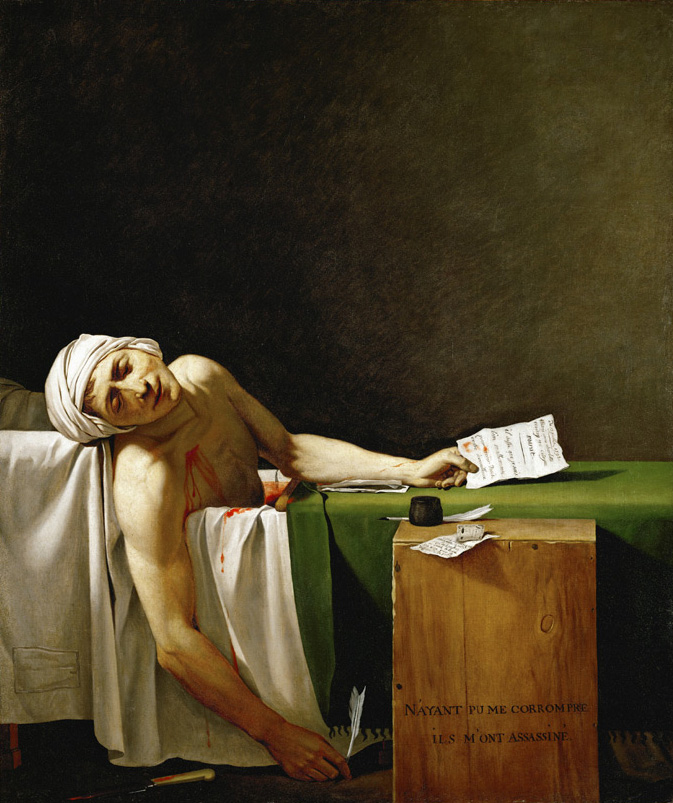
“The Death of Marat” by Jacques-Louis David, perhaps the most iconic bathtub death going

One of the most evocative depictions of bathing in Western culture is a gruesome one. This is “The Death of Marat”, the 1793 painting by Jacques-Louis David, immortalising the murder of his fellow Montagnard and French revolutionary leader Jean-Paul Marat, at the height of the French Revolution, by the Girondin sympathiser Charlotte Corday. The fact that Marat was taking a medicinal bath to treat his notable skin ailments adds a layer of vulnerability, although a layer of complexity is certainly added on top by Marat’s significance during the Reign of Terror and the September Massacres in particular. This painting evidences a different convergence, of the mundane with the electrically political. This is iconic stuff for sure, and an immortal portrayal of the exposure involved in taking a bath. Corday strikes Marat at his weakest.

Contemporary equivalence might be drawn with the shower scene in Alfred Hitchcock’s 1960 horror classic and seminal slasher movie, “Psycho”. Now, I know this occurs in a shower and not a bath but it delves into so many similar themes and preys on such a rich vein of contemporary anxiety that it seems churlish to force the difference. Barely a canonical American horror film has passed since without conjuring up our most horrible, shared, public fears about the yoke of domesticity and what may lurk on the other side of a (in this case, shower) curtain. By all accounts, “Psycho”, and the shower scene in particular, was considered in equal parts revolutionary and abhorrent depending on who was asked. Cinema-goers had never seen anything like it on a mass scale. The cinematography, the score, the image of trickling blood circling the plughole, are all irresistibly imprinted on our cultural retina. The scene is nauseating, features fluid but undeniable sexual elements and marks the point in Western culture when violence, preferably with added sex, became an essential form of both entertainment and commerce. This is the epicentre of a head-spinning sociocultural vortex. What makes the scene even more significant for me is an often overlooked fact. Earlier in the scene is the first occurrence of a toilet being flushed in American cinema. This shattering of a, in hindsight rather weird, taboo is usually understandably forgotten, but clearly incorporates the bathroom as a whole into the stage on which Hitchcock orchestrates an insurrectionary unchaining of mass repression. Every theme involved is just as relevant to the bath, that other porcelain motif of the ideal home. The theme continues to be recycled for less stellar horror films, such as in 2000 flick “What Lies Beneath” and its accompanying promotional material.

This poster for “What Lies Beneath” effortlessly invokes the bathtub as a Hitchcockian symbol of domestic terror

Those are just two of several of our most prominent examples of how the bath intertwines with mortality. Doors frontman Jim Morrison, countercultural prophet and one of the most notable members of the 27 Club, was found dead in a Paris bathtub in 1971. More recently, Whitney Houston was discovered in a similar position, in Beverly Hills in 2012. Kanye West paid a reported $85,000 to adorn the cover of Pusha T’s 2018 “Daytona” album with a picture of Houston’s fatal bathroom, a crass and tasteless act on one hand, but also suggestive of the fact that West understands and channels controversy as well as ever and also appreciates the narrative undercurrents involved in the circumstances. The shot is morbidly fascinating as a twisted photo negative of David’s aforementioned painting and plays with the same horror in a modern context. Musical giants are our modern revolutionaries and like Robespierre, Saint-Just and indeed Marat, they seem to desire a temporal agelessness which currently remains out of their reach. As pleasurable as it can be for each of us, the bathtub is an inglorious enough rock on which to dash the ships of their otherworldly dreams.

Some 400 years earlier was the time of Hungarian countess and alleged serial killer Elizabeth Bathory, who reputedly bathed in the blood of her virginal victims in order to preserve her youth. Although this slice of yore is reportedly in fact a timeless fiction, at least so far as the bloodbath element of the tale goes, it is as evocative a form of cultural myth-making as the deaths of Morrison and Houston. Besides, it is easier to be seduced by such a folkloric yarn when it would make Bathory arguably the best ever example of nominative determinism (run close for me by the American Football cornerback Buster Skrine!). Nothing better summarises how the bath edges us closer to rebirth and death simultaneously than Bathory utilising murder in pursuit of vitality. When we bathe do we yearn to return to the womb as Sandra suggested, or do we surrender ourselves to forces which may undo us in the hope of emerging even better than when we plunged? The thrill of not knowing is part of why we should make the exploration more regularly if we can.

The cover of “Daytona” by Pusha T, which channels Whitney Houston’s death scene at the behest of Kanye West

Not all of our touchstones on this topic are as doom-laden or as leaden. In the 2010 comedy “Hot Tub Time Machine”, after travelling back to the 1980s via a time-travelling hot tub (come on, it’s a form of bath!), one of the protagonists witnesses his own conception in the most existential of the examples I am listing here. The gravitational pull of the thematics surrounding water appliances on the psyche of writers is seemingly very strong. When Alan Partridge looks to help listeners to his Norfolk Nights radio show relax in “I’m Alan Partridge” during his laughable ‘Alan’s Deep Bath’ segment (“brought to you by Dettol”), he can’t help but qualify his mindful instructions with the caveat “don’t fall asleep and slip under; some terrible statistics about that”. Although obviously played for laughs, and successfully, Steve Coogan and Armando Iannucci cannot help but spike the idea of an inviting, soothing bathing experience with a shot of danger and impermanence.

How should we read all of this? If we all take more baths, could we change the world? Are cultural markings of the bath (and wider bathroom) as a hazard a form of unconscious, or even conscious, propaganda? Perhaps not quite, but British governments presumably only reach for the hosepipe ban in drought conditions because a bath ban would be practically unenforceable. I take the evidence of the bath as an icon of potential disaster and of the venue of a complex dance between forces of life and death in popular culture and beyond merely as proof of the state of deep and profound reflection it allows us to access. This places us uniquely in a position of exposure as discussed, which is fertile staging ground within cultural frameworks for the navigation of issues of politics, society, the impossibility of immortality and an incessant striving to recover a childlike sense of contentment. When we bathe, we unplug from the matrix, we care for our mental health and we grant ourselves an essential rejuvenation. In doing all of these things we rebel, which is why we should bathe more.