My very first entry in a series where I plan to write about the stand-up comedy I consume!
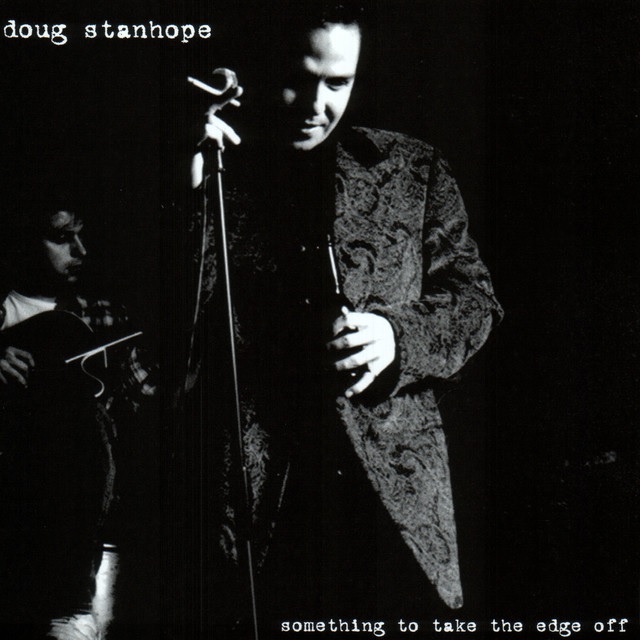
“Something To Take The Edge Off” was released in 2000 after being recorded at The Laff Stop in Houston, Texas and is the second proper album release of Doug Stanhope’s established stand-up career after 1999’s “Sicko”. Where “Sicko” bore the hallmarks of rare acts who find themselves debuting with a greatest hits compilation, this follow-up feels slightly less regimented, not that any of Stanhope’s work ever comes off as particularly stylised, always seeming conversational and boasting an air of structured rambling. It may also be his masterpiece, among a packed catalogue.
At this vantage point of 2022, Stanhope’s work as a stand-up artist ranks among the most essential creative material of the young century, in any field, so naming this record as the standard-bearer of his releases is no small feat. Subsequent records cleave to a similar template but subtly push the envelope, already a more deadly weapon in Doug’s hands than with most, in incrementally more extreme directions. He can pack an hour of any CD or video release with fresh and side-splitting social commentary, always bordering on the tangential and typically radiating an assumed spontaneity, which is an expert sleight of hand for a performer who is an undoubted master of the craft and has a deep and enviable understanding of how to construct a comedy set.
“Something To Take The Edge Off” is thus a mercurial resource and stylistic lodestar in Stanhope’s career; if aspects of subsequent work push the dial even further in terms of excitement, outrage and hilarity, no other piece comes together quite as devastatingly overall, and all of the seeds can be heard being planted here. A central ingredient to the excellence of this record is the titular element, the acoustic guitar backing of musician and comedian Henry Phillips. This lends a singular attraction in the Stanhope canon and represents a meeting of the minds; beyond his general accompaniment, Phillips significantly enhances countless moments, with his instrument a key plank of several jokes. Most notable is a bit where Stanhope directly challenges the audience to name him, one of the most memorable laughs here. The timing of both acts is exquisite. Otherwise, Phillips strums away a number of watermark riffs which remain engrained in my head, ranging from the driving and kinetic to the dreamy and hallucinogenic. The pairing is entirely natural, and serves to simultaneously highlight and amplify the sonic possibilities always inherent in the vocal rhythms of stand-up comedy when usually delivered acapella.
This album firmly establishes Stanhope, early in his recorded output, as an obvious successor to the iconic Bill Hicks in several respects. When this record was released at the turn of the millennium, Hicks had been sadly dead for six years but his reputation as a revolutionary of the form was continuing to spread. Parallels do abound; Hicks’ most astonishing material releases such as “Arizona Bay” and “Rant In E-Minor” were similarly drawn from recordings at The Laff Stop and both took the format in new directions with Hicks’ own musical backing. Of course, most noteworthy are the excoriating political takes and trenchantly vocal advocacy of living outside the box, though the overlaps between the two men and their arguments are not exact. The calibre of the comedic content is undoubtedly comparable.
Stanhope’s unique expressions and sociopolitical comments here are certainly as acerbic and ruthless as his fanbase have grown to expect over the decades. The record features at least a couple of bravura employments of sound effects, a Hicks trademark which there is no shame in failing to quite match him at, and samples of the nascent body horror bits, with an inevitable sexual focus, which Stanhope would utilise even more supremely and unforgettably at various later junctures. Whether describing less explored instances of the ‘wonder’ of the human body or executing a scathing cultural takedown, Stanhope draws immense laughs from an utterly bruising poeticism which, at its finest , never leaves your head once heard. This is one of his greatest gifts, along with a flair for descriptive details which might scan as throwaway if not listening attentively but nonetheless can count among my favourite of his bits, sprinkling Easter eggs between the lines and ensuring a high repeat value.
As mentioned, Stanhope is performatively supercharged by the elusive quality of appearing to be soliloquising casually, erecting a simulacrum of easiness and drunken relaxation which masks a very thoughtfully carved show and coexists uneasily alongside an outwardly exhausted and dismaying persona. This may be the only remotely comfortable part of the experience of listening to him work, which is more widely challenging and mind-expanding in the best ways stand-up can be. He is a comedian with a white-knuckle grasp of momentum and how to effectively build to a crescendo. On this occasion we have clues and indicators to the architecture of the set bookmarked throughout for us in the form of Phillips’ guitar, carefully intertwining the intentions of both performers as they push ahead and cultivate strong audience reactions throughout.
Stanhope culminates proceedings with a major callback, albeit an intentionally crass and inherently dumb one, before diving into a closing long-form story as denouement. Stanhope tends to work by topical chapters but he certainly does set-pieces, with explosive examples littered across the span of his entire career. It is a testament to him that once immersed in his performances, it becomes rather easy to forget that he utilises traditional comic devices; a certain performative amnesia which is most surely beneficial to him. For me, the premier comedic highs of “Something To Take The Edge Off” come where Stanhope provides self-aware comment on his own scale and potential legacy (or lack thereof), including his brilliant perspective on the impact the very album he is recording is likely to have in history. Gladly, he isn’t entirely correct, and here I sit over twenty years later enshrining my views on it!
Like any staple Stanhope release, this set can easily be mined for headline quotations which neatly encapsulate the essence of the artist and his infamous worldview. There are no shortage of those, and like all of his work, this album has often been a salvation for me; a darkly cynical oasis to retreat into after a horrible day at the office or when generally feeling like microwaved human shit. It is an early crest in a battery of performances where the standard barely drops an iota lower, acting as a marvellous microcosm of Stanhope’s now extensive index and rendered especial by the ace card that is Henry Phillips’ sole addition to that oeuvre.
 Roads To The North