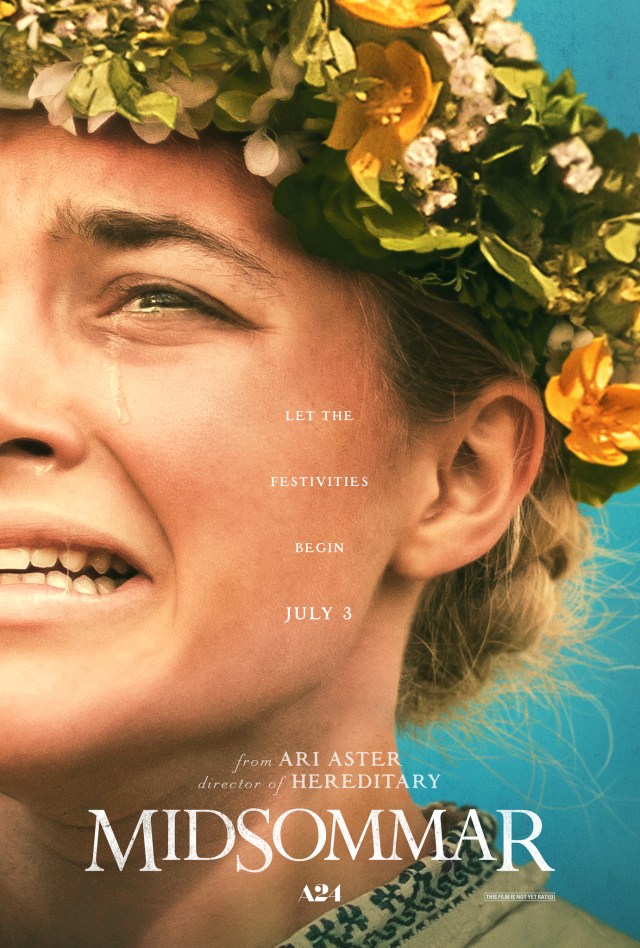
“Midsommar” is Ari Aster’s second full-length writing and directorial effort after 2018’s notable breakout flick “Hereditary”. It shares many of that debut’s hallmarks as far as Aster’s style goes; he is not an artist whose instinct is to reach for the jugular, eschewing such naked ambition as relates to the horror genre in favour of slowly evolving, and in this case deeply felt, tension punctuated by narrative shocks. The effect is to possibly leave some fans of traditional horror wanting more, but general cinema enthusiasts are likely to draw great sustenance from his limited body of work thus far. Contrary to an off-kilter guess by one of my friends, the film is a movie most probably unlike any you have seen before, not a big-screen adaptation of the lightweight British detective show Midsomer Murders(!).
To a greater extent than “Hereditary”, I would venture that “Midsommar” is not a particularly scary film, regardless of how it was marketed. It is an extremely tense and eerie piece which ramps up in carefully prescribed increments. The movie chronicles a grouping of American friends who follow their Swedish college peer Pelle back to Europe to experience a once-every-90-years festival amongst his home community. The main focus is on Dani, played outstandingly by Florence Pugh, who has experienced very recent trauma and whose relationship with her boyfriend Christian (also in attendance and played by Jack Reynor) seems to have entered its death throes. Will Poulter is relied on for much of the comedic sarcasm as Mark and William Jackson Harper is another notable character in the form of Josh. The opening scenes of the film in America are highly critical in establishing the character dynamics at play, which they do very efficiently, clearly portraying Dani’s uneasy relationship with the remainder of the group. Aster’s pacing of the story is tremendous, with great value apparent in the expository scenes which occur around dinner tables throughout, acting as checkpoints for our characters as events spiral.
Aster has rapidly codified his position as a creator whose films come as puzzleboxes. Just as in “Hereditary”, he scatters visual clues as to eventual happenings throughout, generally in the form of actual, expressive images. This merely enhances the foreboding of the film. Having seen both of his films in the cinema with larger groups than I am typically accustomed to attending the multiplex with, I have already noticed that Aster’s work provokes considerable debate as to meaning and leaves the audience walking away with plenty to discuss in terms of what they have actually just seen occur. The use of drawn imagery within the tapestry of the story establishes a roadmap for circumnavigating a collective reading of the film, which has struck me as an effective and interesting callback technique. Although it may be malleable to argued interpretation, Aster likes to weave a mythos.
To me, “Midsommar” has several thematic currents running through it. One seems to be the hidden darkness of social democracy. Scandinavian countries and those generally affiliated to them (chiefly Iceland and, especially, Finland) have been widely acclaimed as paragons of societal excellence. In the same way that those on the Remain side of the hellish fever dream that is Brexit have largely ignored the rise of the far-right throughout mainland Europe across all of the continent’s classic fault lines (to say nothing of the once-unthinkable corresponding rise in fascist thought in the UK itself), any idyllic portrayal of Sweden would need to turn a blind eye to the constant march of the fascistic, nationalist Sweden Democrats party during the last decade, as the issue of immigration (as part of a somewhat unspoken debate on globalisation) has served to poison the body politic of the nation in much the same way as it has around Europe. Reading a rejection of outsiders and foreigners who fail to ‘respect’ and ‘honour’ the norms of a community into a watching of “Midsommar” is not the stuff of academia, although it can just as easily be taken as a play on Americans’ fear of the outside world, toying with American domestic anxiety in the way almost every great American horror film ever made has done.
Although much more subtle, gender relations seem a touchstone here as well, as I shall comment on momentarily. While in the context of the film Midsommar is a fictional festival, it is based on traditional Swedish summer gatherings. Part of the genius of Aster’s writing is to intertwine these ideas with concepts such as ättestupa, ancient Swedish sites where ritual senicide apparently took place, and the ‘blood eagle’ method of ritual execution, also drawn from Scandinavian history. These twists in the tale, among the movie’s wooziest and most nauseous, evidence a beautifully researched film and are embedded effortlessly, lending the movie what I would call a synthetic or confected authenticity from a melding of disparate but interrelated parts, which makes a profound sense to viewers of the film even if only subliminally, and is one of the hardest achievements in writing of any form; Aster seamlessly inserts dusted-down folklore from the cultural framework within which he has set his story, in an expert appeal to the comparatively contemporary form that is the horror movie. The character of Josh has some familiarity with these concepts and seems an on-screen proxy of Aster’s in this sense, as he aspires to complete his thesis on midsummer traditions. Aster still cannot resist a more typical nod to horror, as Josh, a black character, and despite race not having factored into the film overtly, is the first we see meet his end, with what is displayed as an at least minor form of insider knowledge shielding him not one bit once his curiosity gets the better of him and he attempts to steal the commune’s most sacred document.
It was not long after the film’s release before accounts of how some of these festivities have been experienced from a female vantage point surfaced, replete with sexual entitlement and violence. There is nothing to suggest that this is uniquely Swedish; instead, it only seems to be uniquely male, occurring as it does in a patriarchal society. I refer there to Sweden at large but the same seems to apply to Pelle’s community; the gender roles seem very traditionally imagined and, notwithstanding Dani’s merciless redemption, men still seem to be the smirking winners. Although Dani is not exposed to sexual harm on screen, undercurrents of sexual expectation and coercion permeate her one-to-one conversations with Pelle, which are deeply uncomfortable, and seem far more sinister than those she has with her feckless, sad-sack boyfriend Christian, whose behaviour and fashion choices in the movie combined to gain the character a meme as “scoop neck T-shirt guy”, someone women should steer clear of but only for reasons of deceit with a side-serving of significant disappointment. As opposed to Pelle however, he did at least never attempt to crowbar his way into a twisted knight in shining armour narrative as part of a wider scheme to position himself and Dani as figureheads of the cult at the centre of the movie while the bodies pile up in the background.
Both because “Midsommar” is a strange and unsettling film and also because some of it seems written for absurdity, audiences are likely to find themselves laughing as much as gasping throughout. That was certainly the case when I saw it, and this heightens the atmosphere in which this film should be viewed, for me. A scene towards the film’s conclusion when a villager selected by lottery is cheerily prompted to come forward to be considered for execution in the style of a “The Price Is Right” contestant had me suppressing a belly laugh. You may need to check both your pulse and your sense of the comedic if you can get through the film’s crescendo-ing centrepiece of a sex scene without some hysterical chuckling. This soon-to-be infamous scene is among the most musically-inclined of coital presentations I can recall on screen, requiring only the human voice as an instrument. The uniqueness of “Midsommar” unfolding almost entirely in daylight at the height of Swedish summer, possibly unprecedented for a horror flick, is worth mentioning and serves to enhance the already radiant cinematography and use of bold, striking colour throughout. However, to me sound, or more specifically a lack of it, is the most essential element of the film, and this scene is just one example of why.
The film is scored by visionary British producer The Haxan Cloak, whose 2013 album “Excavation” remains an intense capturing of how sound can shift psychic earth. His detailing of how he interrogated traditional folk music, employed a specialist in the interpretation of sacred texts through singing and had his own non-existent instruments crafted in the same vein in order to lovingly and organically ensnare the sound needed to bring “Midsommar” to its maximum potential is well worth tracking down. The score lends the film vitality and is every bit as central to it as any of the acting, photography or writing; there is no hierarchy. All of these facets coexist in a steadying equilibrium constituting the essence of the completed film. Whether he had any involvement in the aforementioned sex scene is not known to me, but would be no surprise since it is entirely operatic.
This synthesis between the writing of the film’s music and Aster’s story itself is best exemplified by an unnamed character; an oracle who is the product of incest. Disabled people seem to have an almost divine status within this community, and the paintings of this individual form the basis for the group’s sacred manuscripts. Although not seemingly formally mute, the oracle is essentially presented as such. Absence of sound becomes integral to the film as it develops. When Christian is paralysed during the movie’s denouement, he is also unable to communicate in any way as he meets a surreal demise. The deceased, who are served up around him in a macabre, ceremonial fashion, are presented in a way which suggests an excision of the head from the human body; a grotesque, mocking neutralisation of the vocal chords. This seems to nod silently to the way in which silence drives horror in certain communities, which spreads like contagion through cities, countries and continents in turn. Some viewers may scoff at my earlier suggestion that there were suggestions of the dynamic of rape or even sexual violence in some of the film’s scenes, but a critical tenet of rape culture is that rape does not have to be mentioned to be considered normal or even to occur. Silence, a central thematic thread of “Midsommar” to these eyes (and ears), brings sexual and political violence in its wake, from the Swedish backwoods to Washington, D.C. Every character to appear in this film deserves a better, more consensual and mutually understanding world.
One of the most astonishing things about “Midsommar” is that it is Aster’s attempt to fuse the traditional slasher film with a breakup film, the latter concept being the one which unlocked the realisation of the former concept for him, based on his own breakup. You cannot help but ask how savage a breakup Aster went through to devise this story, particularly once you have witnessed the choices Dani makes at the movie’s conclusion! One of the other most astonishing things, for which we should give considerable thanks, is that a movie this madcap was commissioned. We need to celebrate the fact that this is one of the barmiest movies you are ever likely to see. There is no doubt that it will divide audiences down its centre; among those I attended it with, one described it as “The Wicker Man turned down”, another independently as “The Wicker Man on speed”! The glorious and sometimes gruesome insanity of the film, which transports us to an otherworld where we catch potent glimpses of our own, ought to be enough for any viewer to take the plunge. Aster has hinted that he is done with horror, and even if “Midsommar” proves to be his magnum opus of horror or just in general, I can’t help but have the impression that what constitutes horror to us may differ significantly to what falls into the bracket for this most enthralling of young writers and directors.







 Roads To The North